
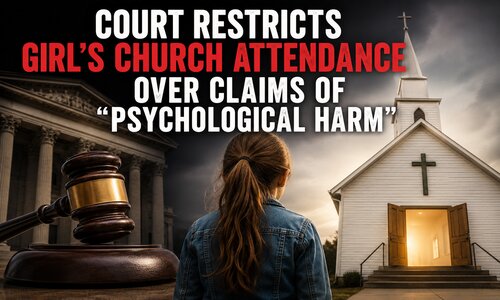
A troubling court ruling out of Maine should have Christians paying attention. The Maine Supreme Judicial Court has upheld an order giving a father final authority to prevent his daughter from attending an evangelical church after arguments that the religious environment was psychologically harmful to the girl.
At the center of the controversy is Calvary Chapel Greater Portland in Westbrook, Maine, where the girl’s mother, Emily Bickford, had been taking her to services. Her father, Matthew Bradeen, objected. In 2024, a Portland District Court gave him authority to determine whether his daughter could continue attending the church, and Maine’s highest court has now upheld that decision.
One of the concerns from the father was that the church was praying for him to repent and receive salvation, which he believed made it seem to his daughter as if he was the enemy. Another striking detail involves what the girl was hearing from the pulpit. Bradeen argued that his daughter experienced anxiety in connection with the church, including a panic attack after hearing teaching about the Rapture.
If The Rapture Is “Harmful,” What Comes Next?
For Bible-believing Christians, alarm bells should immediately be going off. America is entering dangerous territory when courts find themselves deciding whether exposure to Christian teaching contributes to psychological harm serious enough to restrict a child’s participation in a church.
And if the Rapture can become part of that conversation, Christians should consider what could come next. Hell? Judgment? Sin? Repentance? Biblical sexuality? The exclusivity of Jesus Christ?
Christianity contains many doctrines capable of making people uncomfortable. In fact, that is partly the point. The Gospel does not merely affirm us; it confronts us. Scripture tells humanity things modern culture increasingly does not want to hear: We are sinners. We are accountable to God. Judgment is real. Christ is returning. Salvation is found in Jesus Christ alone.
Those teachings can frighten people, offend people and even cause emotional distress. But since when did emotional distress determine whether a religious belief should be protected?
That question matters enormously in modern America because the language surrounding Christianity has changed. Traditional Christian beliefs are increasingly described not simply as outdated or incorrect but as “harmful.”
Biblical teaching on sexuality is called harmful to LGBT youth. Teaching about sin can be described as shame-producing. Christian exclusivity can be portrayed as intolerant. Biblical teachings about men, women and marriage are increasingly characterized as damaging.
var images = [],
index = 0;
images[0] = ““;
images[1] = ““;
images[2] = ““;
images[3] = ““;
index = Math.floor(Math.random() * images.length);
document.write(images[index]);
//done
When “Harm” Becomes The Standard
Now consider what happens when that language moves from the classroom, media and activist organizations into family courts. A parent no longer needs to argue merely that he disagrees with a church; he can potentially argue that the church is harming his child. And once “harm” becomes the standard, judges may inevitably be drawn into deciding which religious messages cross the line.