
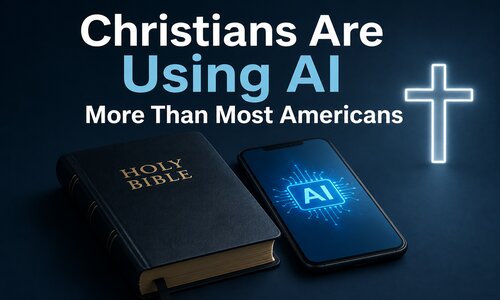
In what some might find surprising, Christians are tapping into artificial intelligence (AI) more than other Americans, with many even trusting it to foster “spiritual growth” within their lives, according to new data from Barna Research.
Barna’s latest research on faith and AI found that “practicing Christians are outpacing nearly every population segment on AI adoption, including pastors.” Yet even within Christian circles, a clear contrast exists between how the average Christian uses AI compared to pastors.
“Pastors understand that AI is out there,” said Daniel Copeland, Barna’s vice president of research, “but they’re not immersed in it the way their engaged congregants may be. The danger for pastors is underestimating just how normal AI is for the people around them. For most practicing Christians, AI isn’t for occasional use. It’s already woven into how they work, learn and make decisions.”
Zoom out and “ask people yes-or-no whether they use AI, and the average pastor and the average American look about the same,” Copeland added. “It’s frequency of use [is] where the difference actually shows up.”
The data shows that 44% of practicing Christians say they use AI “very often” or “often” in their personal lives. Among U.S. adults as a whole, that figure drops to 31%, with only 29% of non-practicing Christians reporting the same. And it’s not just for personal use—26% of U.S. adults across the nation and 39% of practicing Christians use AI often or very often at work.
How Christians Are Using AI
While many practicing Christians say they trust AI to support spiritual growth, most turn to it for far more ordinary purposes. As the researchers put it, “everyday tasks: look something up, learn how to complete a task, get advice on a decision, catch up on the news, sharpen a piece of writing.” Questions related to faith, “like interpreting Scripture or seeking spiritual guidance, show up much further down the list.”
Still, nearly half of the practicing Christian participants said they would trust AI to help with spiritual growth. Approximately one-third report having “turned to AI for spiritual guidance or Bible-related questions in the past month.” Even among those who have sought their pastors’ help in navigating AI, only 12% of pastors believe they are equipped to offer such guidance.
Barna’s own report asked pressing questions: “Where does that leave church leaders, when one-third of practicing Christians want their pastor’s perspective on AI yet most pastors don’t yet feel prepared to give it? Do pastors need to become technology experts to keep up with their congregants?”
var images = [],
index = 0;
images[0] = ““;
images[1] = ““;
images[2] = ““;
images[3] = ““;
index = Math.floor(Math.random() * images.length);
document.write(images[index]);
//done
The Barna Group determined that “pastors don’t need to become AI experts” in order to tend to their flock. “The questions people already bring to AI, about Scripture, relationships, their own struggles, often surface before they ever reach a pastor. Christian leaders who pay attention gain a clearer view of where people are stuck, and one more reason to keep showing up in person for exactly those moments.”
And as Copeland put it, “the better move is for pastors to double down on what they already do well: teaching people how to engage Scripture, building real relationships, making space for analog discipleship. That’s what people can lean on when AI gives them an answer that’s incomplete, misleading or just wrong.”