
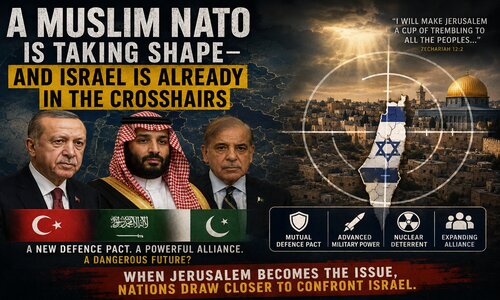
Something potentially historic is taking shape in the Muslim world.
Turkey, Saudi Arabia and Pakistan have signed a new mutual-defense agreement that does far more than promise closer military cooperation. Under the pact, an armed attack against one member will be considered an attack against all three–a collective-defense principle Turkey’s foreign minister has openly compared to NATO’s Article 5.
That alone would deserve attention.
But what happened next should get Israel’s attention.
Within days of the agreement, Pakistan’s defense minister Khawaja Asif called Israel an “illegitimate” state and urged Muslim nations to form a “united military front” against the Jewish state.
Suddenly, what might have been dismissed as another regional security agreement raises a much larger question:
Are we witnessing the early formation of a Muslim NATO–and if it expands, could Israel eventually become one of the threats around which it unites?
Three Nations, Three Different Kinds Of Power
The new alliance brings together an extraordinary combination of capabilities.
Turkey possesses one of the largest militaries in the region and NATO’s second-largest army. It also has a rapidly expanding defense industry producing drones, missiles, armored vehicles and other advanced weapons.
Saudi Arabia brings enormous financial resources, growing military capabilities and something even more important politically: its position as guardian of Islam’s two holiest cities, Mecca and Medina.
Then there is Pakistan.
Pakistan is not simply another Muslim military power.
It is a nuclear weapons state.
That changes the strategic calculation dramatically.
The agreement does not publicly state that Pakistan’s nuclear arsenal would automatically defend Saudi Arabia or Turkey. Officials have emphasized that the pact is defensive and is not aimed at any particular country.
Nevertheless, any alliance containing a nuclear-armed member possesses a deterrent dimension that cannot simply be ignored.
For decades Israel has maintained overwhelming strategic superiority over most of its regional adversaries.
But what happens if an expanding Islamic security structure eventually operates beneath the shadow of Pakistan’s nuclear weapons?
That question alone makes this pact far more significant than another diplomatic ceremony.
And It May Not Stop At Three
Perhaps the most important detail is that the alliance may expand.
Turkish officials have already raised Egypt as a possible future participant, while a permanent ministerial committee and secretariat are being established to oversee the alliance.
Think about what that could eventually mean.
Turkey. Saudi Arabia. Pakistan. Egypt.
Four of the most consequential Sunni Muslim countries would collectively possess enormous manpower, advanced weapons industries, major financial resources, strategic control over critical waterways–and nuclear weapons through Pakistan.
No one should assume such an alliance would automatically become anti-Israel.
Saudi Arabia still has powerful reasons to maintain relations with Washington and has explored normalization with Israel. Turkey remains a NATO member. Egypt has maintained peace with Israel for decades.
But alliances change.
Institutions built today for one crisis can be redirected toward another tomorrow.
That is why Pakistan’s rhetoric matters.
When the defense minister of the alliance’s only nuclear-armed member is already publicly calling for Muslim military unity against Israel, Israelis have every reason to listen carefully.
var images = [],
index = 0;
images[0] = ““;
images[1] = ““;
images[2] = ““;
images[3] = ““;
index = Math.floor(Math.random() * images.length);
document.write(images[index]);
//done
The First Test May Already Be Here
Remarkably, the alliance may not have to wait long before facing its first practical question.
Only days after the agreement was signed, Iran-aligned Houthi forces claimed an attack on Saudi Arabia’s Jazan oil refinery.