
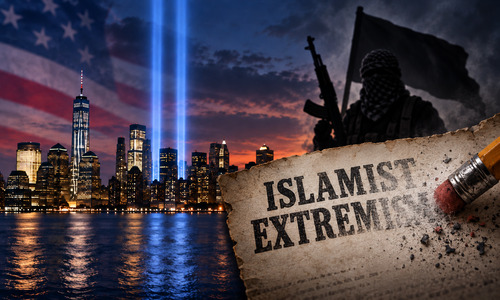
Twenty-five years ago, Americans watched in horror as hijacked passenger jets struck the World Trade Center and the Pentagon, while courageous passengers fought back aboard United Flight 93. Nearly 3,000 innocent people were murdered in a single morning.
America understood immediately that this was not a random act of violence. It was a carefully planned attack by Al-Qaeda, carried out by Islamist extremists who believed the United States was not merely a political rival but a civilization that deserved to be brought down.
For a brief moment, there was moral clarity. Today, the memorials remain, the names are still read and the phrase “Never Forget” continues to appear every September. But America is forgetting—not only what happened, but why it happened.
Remembering The Attack, Forgetting The Ideology
The debate over whether New York Mayor Zohran Mamdani should attend the 25th-anniversary ceremony at Ground Zero has exposed just how fractured the country’s understanding of 9/11 has become. Some victims’ families and former New York leaders have urged him to stay away, while Mamdani has said he will attend to honor the dead and the first responders.
But the larger issue is not who stands at the ceremony. It is whether America still possesses the courage to identify the ideology that sent 19 hijackers into those airplanes.
The United States declared a “war on terror,” but terror is a tactic, not an enemy. The enemy was a global Islamist movement committed to imposing its religious and political order, destroying Israel and weakening the West. The bipartisan 9/11 Commission Report documented Al-Qaeda’s rise, Osama bin Laden’s declaration of war against the United States and the extremist worldview that drove the plot.
America eventually soured on the wars in Afghanistan and Iraq—and understandably so. Lives were lost, trillions were spent and grand promises to transform the Middle East collapsed. Yet the failure of nation-building did not mean the original threat was imaginary.
America confused a failed response with a nonexistent enemy.
var images = [],
index = 0;
images[0] = ““;
images[1] = ““;
images[2] = ““;
images[3] = ““;
index = Math.floor(Math.random() * images.length);
document.write(images[index]);
//done
A Generation That Knows 9/11 Through A Screen
The country now faces another danger: an entire generation has grown up without any personal memory of September 11.
Today’s high school students were not alive when the towers fell. Many of their teachers were children themselves. For them, 9/11 is not a memory. It is content—encountered through brief classroom lessons, documentaries, social-media clips, influencers and online arguments.
Those who lived through 9/11 remember the confusion, the smoke pouring from Manhattan, people jumping from the towers and first responders running toward buildings everyone else was fleeing. They remember the Pentagon burning and the haunting silence that descended over American skies.
Young people encounter those events through algorithms that often reward outrage, conspiracy and historical revisionism. Online narratives can present the attackers as victims of American foreign policy, minimize Islamist ideology or suggest that the United States somehow brought the slaughter upon itself.