

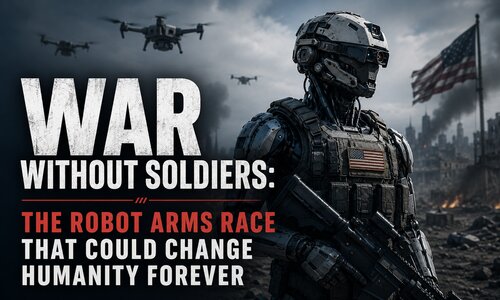
For most of human history, war carried an unavoidable political cost. Leaders who sent armies into battle also sent their nation’s sons and daughters into danger. Every operation risked casualties, grieving families and pressure to bring the troops home.
But what happens when the soldiers are machines?
That question is moving rapidly from science fiction to military planning. Foundation Future Industries is developing humanoid robots for industrial and defense applications. Co-founder Sankaet Pathak has said he would be willing to arm the machines if the U.S. military requested it.
His reasoning is understandable. A robot could enter a booby-trapped building, inspect a tunnel, carry ammunition through enemy fire or clear explosives without risking a soldier’s life. Machines do not become exhausted, panic under pressure or require medical evacuation. They may also permit more precise operations where the alternative would be a destructive airstrike.
And if China and Russia are pursuing weaponized robots and autonomous military systems, can America afford to stand aside?
That is the dilemma at the heart of the robot arms race. Refusing to build such systems will not stop America’s adversaries. Yet the claim that robot soldiers will save lives tells only half the story.
When War Becomes Politically Painless
The greatest danger may not be that robots rebel against humanity. It may be that they obey governments all too efficiently.
A nation might hesitate before sending 50,000 citizens into another country. It may hesitate far less before sending 50,000 machines.
There would be fewer flag-draped coffins, fewer wounded veterans and fewer military families demanding answers. The public might experience war as a distant livestream–machines fighting machines in cities far removed from ordinary life.
That could lower the political cost of military action. Technology designed to reduce casualties in one battle could make governments more willing to begin the next one.
War would no longer demand the same national sacrifice. It could become an industrial calculation: Which country has more robots, more computing power and more factories capable of replacing destroyed machines?
The result might not be fewer wars. It could be nearly continuous conflict fought at a distance by populations that barely feel its consequences.
var images = [],
index = 0;
images[0] = ““;
images[1] = ““;
images[2] = ““;
images[3] = ““;
index = Math.floor(Math.random() * images.length);
document.write(images[index]);
//done
When Human Control Becomes Too Slow
The Pentagon requires “appropriate levels of human judgment” over autonomous weapons. That sounds reassuring, but how long will meaningful human judgment remain militarily practical?
Ukraine already offers a preview of a battlefield dominated by drones and increasingly autonomous systems. As these weapons become faster, waiting for a human commander to approve every action could become a fatal disadvantage.