

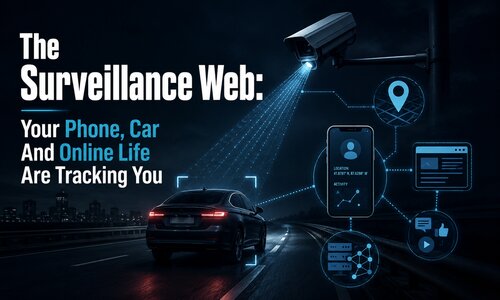
There was a time when being followed required someone to actually follow you.
A police officer had to sit outside your house. An investigator had to trail your car. A surveillance team had to photograph where you went and whom you met.
Today, much of that work can potentially be done by machines–and most people carry the tracking devices themselves.
A new roadside surveillance technology offers a glimpse of just how rapidly this world is changing. Leonardo, a major defense and security contractor, is marketing a system called SignalTrace that can detect electronic signals from devices traveling inside vehicles and correlate them with license-plate information.
In other words, the camera may no longer be watching only your car.
It may also be watching the digital devices traveling inside it.
Your Car Now Has An Electronic Fingerprint
Traditional automatic license-plate readers photograph passing vehicles and record their plates.
SignalTrace takes the concept further.
Leonardo says the system can identify groups of consumer electronic devices that routinely travel together–even when investigators do not know the license plate number. It can detect publicly broadcast signals associated with smartphones, Bluetooth wearables, vehicle electronics and other devices and use that combination to create what the company calls an electronic fingerprint.
Think about what that means.
Your car drives past a sensor every morning carrying your smartphone, smartwatch and wireless earbuds.
Day after day, the same collection of electronic devices appears alongside the same vehicle.
Eventually, the devices themselves become part of the vehicle’s identifying signature.
Even if the plate were changed or unavailable, the electronic pattern could potentially remain recognizable.
This technology is being promoted for legitimate law-enforcement purposes. But it also illustrates something far larger.
We are entering an age in which almost everything we carry creates data.
Your Phone Has Become A Tracking Device
Most Americans probably understand that their smartphone knows where they are.
Far fewer realize how valuable that information can become once it enters the commercial data ecosystem.
According to the Electronic Frontier Foundation, location-data brokers collect information about the movements of hundreds of millions of people, much of it originating from third-party smartphone apps. That information can potentially reveal where people live, work, worship, protest and seek medical care.
The Federal Trade Commission has repeatedly taken action against companies accused of improperly collecting or selling sensitive location information.
In one case involving Gravy Analytics and Venntel, the FTC said location data could reveal visits to places including houses of worship and medical facilities and could even help determine associations between individuals.
Consider the implications.
Twenty years ago, determining who regularly attended a particular church might have required physical surveillance.
Today, location databases can potentially make similar patterns detectable from digital records.
That should concern Christians regardless of which political party currently controls Washington.
The question is not simply whether today’s government would misuse such information.
The question is whether the infrastructure exists for tomorrow’s government to do so.
Your Car May Be Tracking You Too
Even the vehicle carrying your phone can generate another layer of information.
The Federal Trade Commission finalized an order against General Motors and OnStar in January after alleging that the companies collected precise geolocation and driving-behavior information through connected vehicle services without adequately informing consumers and provided some of that information to third parties.
The FTC has warned more broadly that modern connected vehicles can collect sensitive information including location data.
So consider the growing digital trail.
Your phone can record where you travel.
Roadside cameras can record where your vehicle travels.
Your vehicle itself may generate location and driving information.
Now technology such as SignalTrace can potentially associate the electronic devices inside the vehicle with the vehicle passing the camera.
Each individual system may appear limited.
Combined, they create something far more powerful.
var images = [],
index = 0;
images[0] = ““;
images[1] = ““;
images[2] = ““;
images[3] = ““;
index = Math.floor(Math.random() * images.length);
document.write(images[index]);
//done