

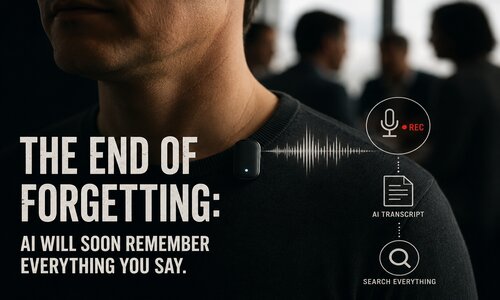
For most of human history, conversation was temporary.
You could sit across from a friend at lunch, talk with your spouse in the kitchen, debate politics with coworkers, counsel someone at church or make an offhand remark—and unless someone deliberately wrote it down or recorded it, those words disappeared into memory.
That assumption is beginning to collapse.
A new generation of wearable artificial intelligence devices is being designed to accompany people throughout the day, listening to conversations and transforming them into transcripts, summaries, reminders and searchable personal histories.
Amazon’s Bee wearable, for example, processes conversations throughout the day and uses them to understand a user’s patterns, preferences and relationships. Amazon says the device processes conversations without retaining the original audio, but the information extracted from those conversations can still become part of the personalized AI experience.
Plaud’s NotePin S can be worn on the body and is designed to record conversations, transcribe them and generate AI summaries.
Limitless developed an AI pendant around an even more ambitious concept: record large portions of your day and allow artificial intelligence to organize, summarize and search what happened. Its system has allowed users to retain audio anywhere from a day to indefinitely, depending on their settings.
The convenience is obvious.
Never take meeting notes again.
Never forget what someone promised.
Ask your AI what your doctor told you six months ago.
Search a conversation from last year.
Automatically generate a list of everything you agreed to accomplish this week.
But underneath that convenience is a much larger transformation.
We are moving from the Internet remembering what you typed to artificial intelligence remembering what you said.
And that raises one of the most important privacy questions of the AI age:
Who controls the memory?
Your Digital Footprint Is About To Get Much Bigger
Americans already leave enormous trails of digital information.
Our phones know where we travel. Search engines know what interests us. Online retailers know what we purchase. Social networks know who our friends are. Apps can collect information about our habits, movements and preferences.
Wearable AI adds something enormously valuable to that profile:
our actual conversations.
What do you worry about?
What does your marriage look like?
What do you think about your employer?
What political opinions do you express privately?
Which medical problems are you discussing?
What are your financial concerns?
Who are you meeting?
What did you promise someone?
What subjects make you angry, frightened or excited?
Conversation contains information that people would never deliberately type into Facebook or enter into a Google search.
Yet increasingly, that information can be captured, converted into text, categorized and made searchable.
A searchable transcript is fundamentally different from a recording sitting forgotten on a hard drive.
AI can potentially identify names, subjects, dates, decisions and recurring themes across thousands of conversations.
What once required someone to listen through hundreds of hours of audio could eventually require a simple question:
“Show me every conversation in which this person criticized his employer.”
That changes the value of the data dramatically.
var images = [],
index = 0;
images[0] = ““;
images[1] = ““;
images[2] = ““;
images[3] = ““;
index = Math.floor(Math.random() * images.length);
document.write(images[index]);
//done
The Person Being Recorded May Not Even Own The Device
There is another problem that receives far too little attention.
The purchaser of an AI wearable may have willingly agreed to being recorded.
Everyone standing around him did not.
Imagine walking into a business meeting and discovering that someone’s necklace has been creating an AI transcript.
Or speaking privately with a friend whose wearable is quietly documenting the conversation.
Or a pastor counseling a church member.