

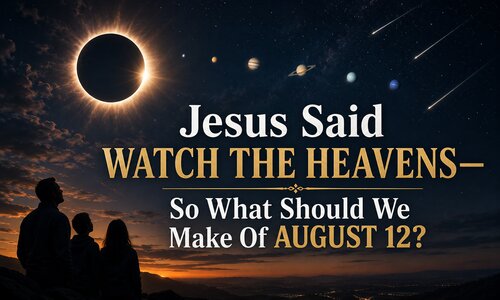
Something unusual is about to happen in the heavens.
Before sunrise on August 12, six planets will be spread across the morning sky. Later that same day, the moon will pass directly between the Earth and sun, producing a total solar eclipse across portions of the Northern Hemisphere. Then, as darkness falls, one of the year’s most spectacular meteor showers will be reaching its peak.
It will be quite a day to look up.
NASA confirms that the August 12 total solar eclipse will sweep across Greenland, Iceland, northern Russia, the Atlantic Ocean, Spain and a small portion of Portugal. Parts of North America, Europe and Africa will experience a partial eclipse.
At roughly the same time, the Planetary Society says a six-planet “parade” will stretch across the predawn sky for several mornings. Jupiter, Mercury, Mars, Uranus, Saturn and Neptune will all be present, although Uranus and Neptune will require optical assistance to see.
And then there are the Perseids.
The American Meteor Society places the 2026 Perseid maximum around August 12-13, with virtually no moonlight to interfere with viewing. The Perseids are among the most anticipated meteor showers of the year, producing brilliant streaks of light across summer skies.
None of those things, by themselves, are supernatural.
Eclipses are predictable. Planetary movements are predictable. Meteor showers occur as Earth passes through debris left behind by comets.
But Christians should be careful about going from that scientific observation to another conclusion increasingly common in our secular age: that because something has a natural explanation, it therefore cannot have spiritual significance.
The Bible never makes that distinction.
Jesus Told Us To Look Up
When Jesus described conditions surrounding the end of the age, He included a remarkable statement:
“There shall be signs in the sun, and in the moon, and in the stars.” — Luke 21:25
That should at least get our attention.
Jesus didn’t tell His disciples to practice astrology.
But He did tell them that the heavens would matter.
That idea doesn’t begin in Luke.
Genesis 1:14 tells us that God created the lights in the heavens “for signs, and for seasons, and for days, and years.”
The prophet Joel spoke of “wonders in the heavens” and declared that the sun would be turned to darkness before the great and terrible Day of the Lord.
Jesus repeated similar imagery in Matthew 24.
And Revelation describes dramatic disturbances involving the sun, moon and stars as God’s judgments unfold.
In other words, Scripture repeatedly tells us that the God who created the heavens is perfectly capable of using them to get humanity’s attention.
var images = [],
index = 0;
images[0] = ““;
images[1] = ““;
images[2] = ““;
images[3] = ““;
index = Math.floor(Math.random() * images.length);
document.write(images[index]);
//done
The Danger Of Going Too Far
That doesn’t mean every eclipse is a prophecy.
Christians have repeatedly embarrassed themselves by assigning specific prophetic significance to astronomical events only to watch the predicted dates come and go.
We should learn from that.
There is no biblical passage saying that an eclipse on August 12, 2026 will trigger a war, economic collapse, earthquake or the return of Christ.
We should not manufacture prophecy where Scripture has given none.
The events themselves are remarkable enough. They don’t need embellishment.
But avoiding sensationalism does not require adopting the opposite extreme.
There is a difference between date-setting and watchfulness.