

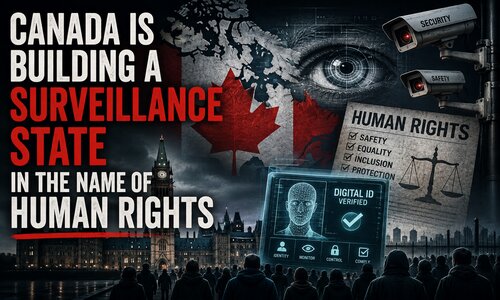
If someone proposed a law giving government broad authority to monitor online speech, verify citizens’ identities before accessing digital platforms, compel technology companies to remove “harmful” content, and punish citizens for expressing ideas deemed unacceptable by government-appointed regulators, most Canadians would likely reject it outright.
But history suggests that free societies rarely surrender their liberties overnight. Instead, governments tend to expand their authority gradually. One law protects children. Another combats hate. Another fights misinformation. Another strengthens national security. Each proposal appears reasonable when viewed on its own. Collectively, however, they can begin to reshape the relationship between citizens and the state.
That is why Canada’s growing legislative push into digital regulation deserves careful attention. Civil liberties advocates, privacy experts, and free speech organizations have increasingly warned that the country is constructing something larger than a collection of unrelated laws. They argue Canada is gradually building the legal and technological infrastructure needed to monitor digital activity, regulate online expression, and expand government oversight of public discourse.
For generations, human rights were understood primarily as protections that limited government power. Freedom of speech, freedom of religion, freedom of conscience, due process, and privacy existed to safeguard individuals from state interference. Governments were expected to defend those liberties–not determine when they could be suspended.
Increasingly, however, that understanding appears to be changing. Rights are no longer viewed solely as freedoms government must protect, but as claims government must actively enforce–even if doing so requires limiting someone else’s liberty. Protecting one person’s dignity may involve restricting another person’s speech. Preventing harm may require expanded surveillance. Promoting inclusion may justify compelling certain forms of expression while discouraging others.
Whether viewed as progress or cause for concern, this represents a profound shift in the philosophy of individual rights.
That shift is increasingly reflected in public policy.
Recent legislative proposals and enacted laws in Canada have expanded government involvement in regulating online platforms, retaining digital communications data, creating new digital safety regulators, strengthening oversight of online content, and exploring age-verification systems that could require users to verify their identities before accessing portions of the internet. Supporters argue these measures are necessary to protect children, combat online exploitation, reduce extremist content, and make digital spaces safer.
Those are legitimate public policy goals. Yet critics argue that, taken together, these initiatives are also constructing something else: the infrastructure through which governments can exercise unprecedented influence over digital life.
History offers an important lesson. Effective censorship rarely begins with banning speech. It begins with identifying who is speaking.
var images = [],
index = 0;
images[0] = ““;
images[1] = ““;
images[2] = ““;
images[3] = ““;
index = Math.floor(Math.random() * images.length);
document.write(images[index]);
//done
Age verification increasingly requires identity verification. Identity verification increasingly relies upon biometric information, facial recognition, government-issued credentials, or centralized digital authentication. Anonymous participation becomes more difficult. Metadata retention enables authorities to reconstruct digital activity long after conversations have ended. Regulatory bodies gain expanding authority to determine what content should remain online and what should be removed.
Individually, each measure may appear modest. Collectively, they establish capabilities that previous generations of governments simply did not possess.
Technology has fundamentally transformed the nature of governmental power.
A century ago, censorship often meant banning newspapers or confiscating printed materials. Today it can involve algorithmic suppression, account suspensions, search-result manipulation, payment processor restrictions, internet blocking, or artificial intelligence capable of monitoring billions of online interactions in real time. Modern censorship is often subtle enough that many citizens never realize it has occurred.